Directive-based governance solves one of the most common scaling problems: decisions that used to happen over coffee now fall through the cracks. When your team is 5, you align verbally. At 50 or 500, you need a system. Over 15+ years and 1000+ projects across 38 countries, I developed a practical directive framework that I deploy in every engagement as a fractional CTO.
- What Is Directive-Based Governance and Why It Works
- Temporary vs Permanent Directives: When to Use Each
- Patches and Versioning: Updating Directives Without Chaos
- Artifacts: Long-Term Policies with Annual Review
- Bug Tracking for Violations: Treating Deviations Like Software Defects
- Three Essential Roles in the Directive System
- The Quarterly Review Cycle: Keeping Directives Current
- How to Implement a Directive System: Step-by-Step
- Frequently Asked Questions
- How is a directive different from a corporate policy?
- How many directives does a company need to start?
- Does the golden share work in flat organizations?
- How do you convince a team to adopt a directive system?
- Need a Consultation?
What Is Directive-Based Governance and Why It Works
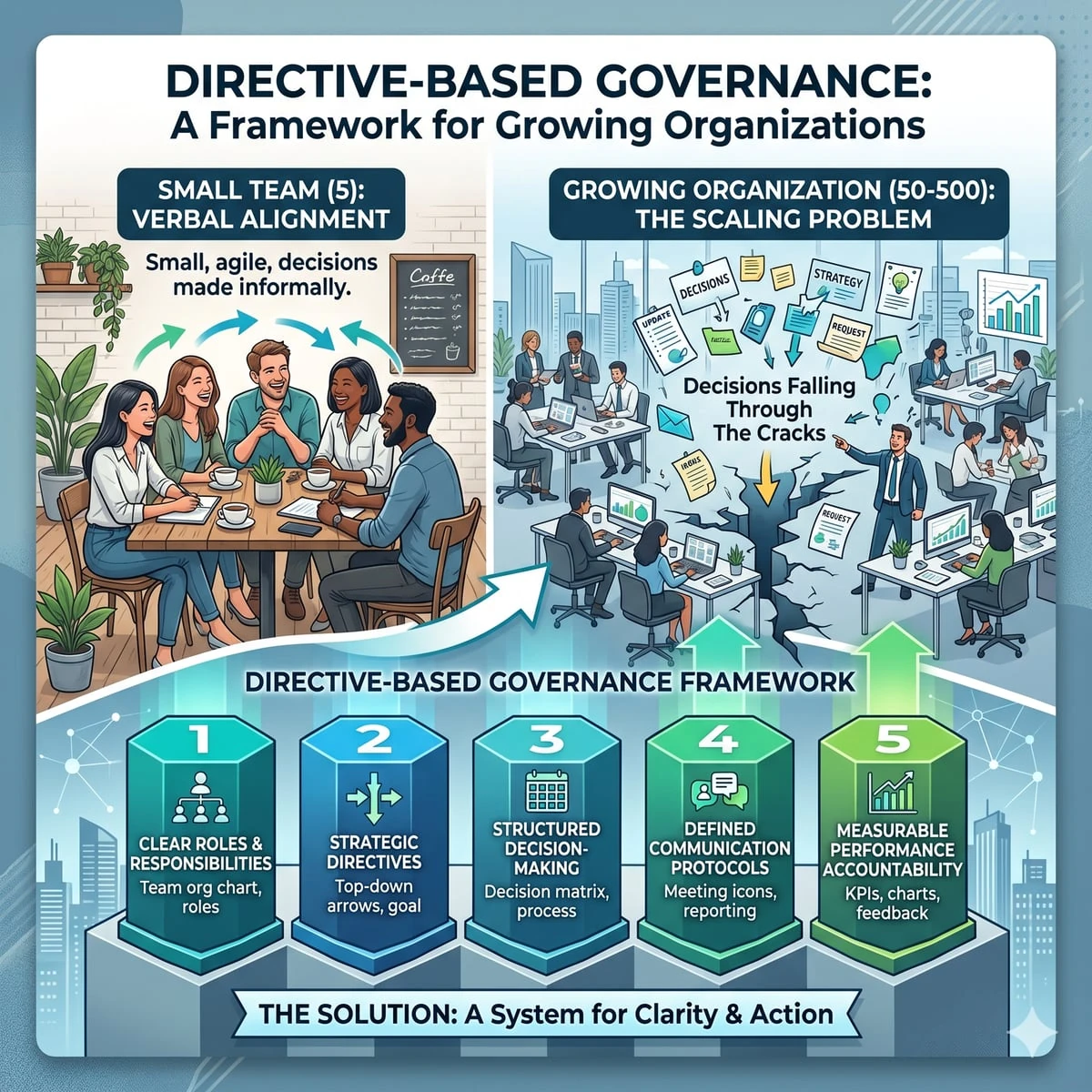
A directive is an internal document with the force of law. Unlike vague “corporate policies,” a directive is specific: it defines a problem, prescribes a mandatory solution, includes a validity period, success criteria, and consequences for violation.
I use directives as the primary operational management tool. Not 200-page regulation manuals, but short, concrete documents that every team member must read and acknowledge with a signature. They take effect immediately upon publication.
Organizations that adopt directive-based governance gain three things: decision transparency (everyone knows the rules), speed of reaction (a new directive takes effect instantly), and measurability (every directive has KPIs).
Temporary vs Permanent Directives: When to Use Each
Every directive is either temporary or permanent. Temporary directives are experiments with a fixed horizon. You test a new process, metric, or rule. If it works, promote it to permanent. If not, archive it without consequences.
Permanent directives form the foundation. They ensure stability, communication consistency, and process predictability. For a mid-size organization, I recommend a 70/30 split: 70% temporary (flexibility) and 30% permanent (stability). Revisit this ratio quarterly based on external factors, team feedback, and performance data.
When I implemented this at MStar (retail fintech, 140+ locations), we started with 80% temporary directives because the team had never experienced formalized governance. Six months later, the ratio stabilized at 60/40.
Patches and Versioning: Updating Directives Without Chaos
A directive is a living document. Changes are applied through patches, analogous to software development. A major patch modifies the directive’s text (e.g., revises a procedure). A minor patch supplements without changing the core text (adds an exception or clarification).
Each patch goes through a team vote. Majority rules in most cases. However, a designated person, typically the CEO or CTO, holds a “golden share”: the ability to veto a decision in exceptional circumstances. The criteria for exercising this veto must be defined in advance; otherwise, the system devolves into authoritarianism.
Numbering is straightforward: year-month-sequence. Directive 2026-06-03 is the third directive of June 2026. Patches add a suffix: 2026-06-03.p1 (first patch).
Artifacts: Long-Term Policies with Annual Review
After several quarters of proven effectiveness, a permanent directive can be elevated to artifact status. An artifact is a long-term policy reviewed annually instead of quarterly. Artifacts form the company’s DNA: values, security standards, customer engagement principles.
From artifacts emerge two key documents: strategies (forward-looking) and missions (experience-based). They don’t replace strategic planning but give it a concrete foundation. Learn more about my approach to strategic planning.
Bug Tracking for Violations: Treating Deviations Like Software Defects
Any deviation from a directive or artifact is a bug. Just like in software development. I distinguish two types:
- One-time bugs: isolated violations. Tracked by two parameters: recurrence and severity. If a bug repeats three times, it becomes a systemic issue
- Systemic bugs: recurring deviations that point to a flaw in the directive itself or in team training. Assessed by importance and frequency
Maintaining a directive bug tracker sounds bureaucratic, but in practice it takes 10 minutes per week, and gives you a complete picture of which rules work and which need revision. In a complexity management project, bug tracking reduced repeat violations by 40% within one quarter.
Three Essential Roles in the Directive System
The system requires three roles. In a startup, one person can fill all three. In a corporation, they are distributed across the team.
Directive Curator, responsible for distribution, notification about new rules, and ensuring everyone has read and acknowledged them. This is a communication role.
Violation Manager (Bug Fixer), discovers, analyzes, and resolves deviations. Works with specific cases and tracks patterns.
Team Member Needing Training, an employee whose actions cause violations. The key principle: we train, not punish. A person is not a “bug generator” but someone who needs competency development. This approach preserves team trust.
The Quarterly Review Cycle: Keeping Directives Current
Every quarter, all active directives undergo review. Each can be:
- Confirmed without changes
- Updated with a patch
- Promoted to artifact (if proven valuable)
- Archived (if no longer relevant)
Key review triggers: changes in the external environment, team growth or restructuring, employee feedback, bug tracker data, and regulatory changes. This cycle takes no more than one working day per quarter but prevents the accumulation of outdated rules.
How to Implement a Directive System: Step-by-Step
Based on my experience implementing this in companies of 10 to 500 people, here is the working algorithm:
- Start with 3-5 directives targeting your most painful processes (don’t try to formalize everything at once)
- Make them temporary with a 90-day horizon
- Appoint a curator (usually HR or the operations lead)
- Set up a simple bug tracker (a Google Sheets table is enough)
- Conduct the first quarterly review and adjust
- Scale: add 2-3 directives per month as you grow
The biggest mistake is trying to cover everything from day one. A directive system works iteratively, like any management tool. More about my approach to business process automation.
Frequently Asked Questions
How is a directive different from a corporate policy?
A directive is a specific, enforceable document with a validity period and success criteria. A policy is a general framework document. A directive says “effective June 1, all database queries go through the API gateway; violation is a P1 bug.” A policy says “we value data security.” Directives are executable and measurable.
How many directives does a company need to start?
3-5 temporary directives targeting the most critical processes. More and the team won’t absorb them. Fewer and the system won’t demonstrate its value. After 2-3 quarters, the count typically stabilizes at 15-25 active directives for a company under 100 people.
Does the golden share work in flat organizations?
Yes, if the veto power is tied to function rather than title (e.g., CTO on security matters, CFO on financial directives). In holacratic structures, the golden share can be distributed across multiple roles with different scopes.
How do you convince a team to adopt a directive system?
Start with a problem everyone recognizes (e.g., inconsistent client request handling). Propose a temporary 90-day directive. Show results at the first review. Coercion doesn’t work, only demonstrated value does.
Need a Consultation?
If you need expert guidance in building a governance framework, book a free 15-minute consultation. I will help you choose a directive model tailored to your industry and company size.