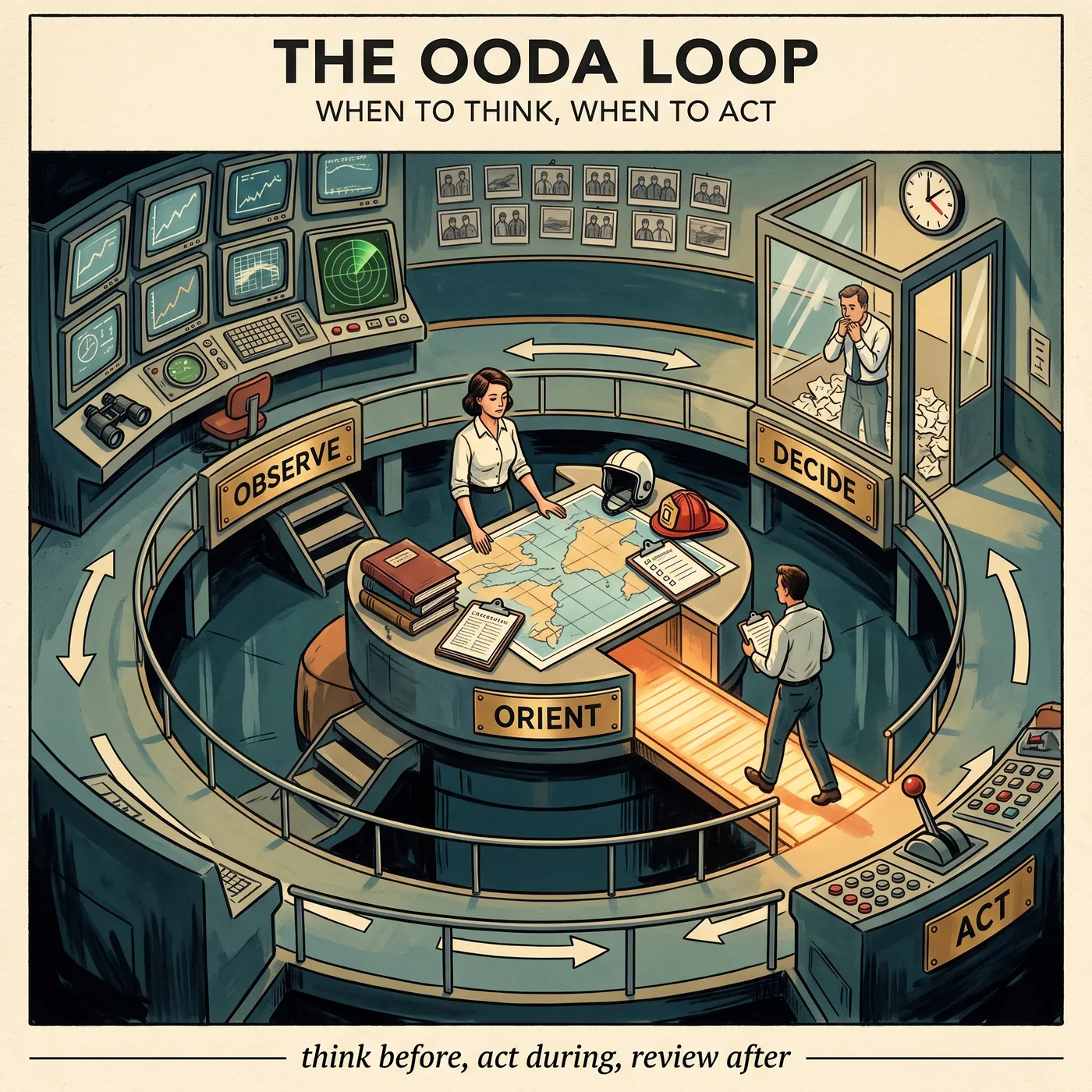
The OODA loop comes from the American fighter pilot John Boyd: observe, orient, decide, act. It is usually retold as “cycle faster than your opponent”. What interests me in it is something else: where people get stuck inside it. Under pressure many people do not act worse, they stop acting at all. They freeze and start re-examining a process they have known for years: rebuilding the picture, doubting the plan, looking at the same data again. The stronger the stress, the longer they stay there.
This article is about how to spread thinking across the loop so you do not fall into that trap. In short: think before and after, execute during. When you can trust experience and intuition, and when you must stop and think, is answered by research, not taste. A word on the frame. This is not psychotherapy and not advice for trauma, it is an account of how decisions work under pressure, for leaders and for anyone who has to decide fast. Every fact below was checked twice against primary sources, with links at the end. Where a study is small or disputed, I say so.
- Freeze and the other scenarios: what stress does to us
- Cognitive traps under pressure
- The OODA loop as Boyd himself drew it
- Where people get stuck: the orient phase
- When to trust intuition and when to think
- Boyd’s shortcut: how preparation turns a decision into recognition
- How to spread the loop: before, during, after
- Before: think slowly
- During: execute
- After: a review without blame
- For leaders: how not to drag the team into your freeze
- Myths worth letting go
- A short checklist
- Frequently asked questions
- What is the OODA loop in simple terms?
- When can you trust intuition?
- Why do people freeze under stress?
- How do you prepare for decisions under pressure?
- What should a leader do during an outage?
- Sources
- Need a consultation?
Freeze and the other scenarios: what stress does to us
The phrase “fight or flight” goes back to the physiologist Walter Cannon in 1915. He noticed that the body prepares for action the same way whatever happens next, flight or fight. Researchers today describe the response to threat more broadly, as a defense cascade. The order matters, because what usually comes first is neither fight nor flight but freezing.
- Freeze. A short state at the very start of a threat: attention sharpens, the body is tense and ready to act. The neuroscientist Karin Roelofs describes freezing not as passivity but as a brake that serves perception and action preparation. In a shooting-under-threat experiment, stronger midbrain activity during the freeze predicted faster accurate shots afterwards. The problem is not freezing itself, it is not coming out of it.
- Fight. Pushing, arguing, pressure. In management this is the leader who starts shouting at the team during an outage and looking for someone to blame on the spot.
- Flight. Leaving the situation: switching to something else, postponing, “let me clear my inbox first”.
- Tonic immobility. The person cannot move or call for help when neither escape nor winning seems possible. This is no longer a choice, it is an extreme bodily response.
- Flop. Research calls it collapsed immobility: muscle tone drops and awareness blurs. The word “flop” comes from survivor-support organisations, the scientific term is different.
- Fawn. A term from the psychotherapist Pete Walker (2003): seeking safety by pleasing others and giving up one’s own needs. It is a clinical concept from trauma work, not a research category, but it is easy to recognise at the office: someone agrees to an obviously bad decision just so the tension goes away.
- Tend and befriend. In 2000 Shelley Taylor described a response in which people under stress protect those close to them and seek support. It was first thought to be female, but a 2012 study with men found that acute stress raised their trust and sharing too. There is contrary evidence as well: in a 2024 study, people under stress were less willing to put in effort for others, at least when the effort required was low.
Which of these switches on, in the trauma researchers Schauer and Elbert’s model, depends on how a person weighs the threat against their own power to act. That gives the main practical point, which I return to below: a sense of control protects thinking by itself. In a 2009 review the neuroscientist Amy Arnsten writes that the prefrontal cortex, which handles planning and self-control, is the part of the brain most sensitive to stress. Even mild acute stress that a person cannot control can impair it quickly and dramatically. People who felt in control, even when that control was an illusion, often showed no such impairment.
Cognitive traps under pressure
Bodily responses are half the picture. The other half is how stress changes thinking. These are the traps that most often break a leader’s decisions.
- Rethinking mid-execution. This is the freeze in thinking. Psychologists call it choking under pressure. In 1992 Rich Masters described the mechanism: under pressure a person tries to consciously run a skill that has long run by itself, and the skill falls apart. Sian Beilock showed the same with experienced golfers: when asked to attend to each step of the movement they played worse, while novices played better. Experience lives in automatic routines, and taking them apart by hand at the moment of execution breaks exactly the experience.
- Tunnel vision. As early as 1959 James Easterbrook proposed that under strong arousal people use fewer cues and lose the peripheral ones first. NASA researchers describe the same in the cockpit: acute stress narrows attention and reduces working memory.
- A hasty, unsystematic decision. In Giora Keinan’s 1987 experiment, people under stress offered a solution before considering all the alternatives and scanned them unsystematically, even when time was not limited. This is the other side of the freeze: a lunge instead of a stall.
- Continuing the plan against the facts. NASA calls it a deep-rooted tendency to continue the original plan when conditions already require a new one. In a review of 19 airline accidents this error appeared in at least nine. The authors stress that almost any experienced pilot in the crew’s place, knowing only what the crew knew, would have been just as vulnerable. It is not about bad people.
- Avoiding the decision. What everyday language calls analysis paralysis, research calls decision avoidance. It takes four forms: deferring the choice, sticking with the status quo, preferring omission to action, and inaction inertia after a missed opportunity. Its main drivers include cost-benefit calculations, anticipated regret and the difficulty of choosing.
- Rumination. Repetitive thinking about one’s own distress, its causes and its consequences. Susan Nolen-Hoeksema’s research shows that rumination is not deep thinking: it impairs problem solving and strengthens negative thinking.
- Falling back on habit. In 2009 Lars Schwabe and Oliver Wolf showed that stress shifts people from goal-directed behaviour to habit. Under stress you do what you trained. This is both a trap and the main lever: if the right thing is trained, stress works for you.
- Micromanagement in panic. A leader under pressure pulls all control to themselves. Back in 1986 Boyd wrote that each level of an organisation has its own OODA loop, and it lengthens the more levels and details are controlled from the top. A leader’s panic slows the whole team.
A separate note on cognitive biases: confirming your own hypothesis, anchoring on the first number, reluctance to write off what has already been spent. Under pressure they most likely get stronger, because checking yourself needs the same attention that stress has already eaten. Daniel Kahneman and Gary Klein note that self-monitoring suffers when the mind is busy with another demanding task. These biases will get an article of their own.
The OODA loop as Boyd himself drew it
John Boyd (1927-1997) was a US Air Force colonel, fighter pilot and instructor. He wrote no books: his ideas survive in a few papers, the best known being “Destruction and Creation” (1976), and a series of briefings. He drew the OODA diagram in his last briefing, “The Essence of Winning and Losing”, first dated 28 June 1995 and last revised in January 1996, a little over a year before his death. I mentioned the OODA model in Managing Complexity through Cycles, and here I take it apart in detail.
On that diagram the loop looks nothing like the four-step circle usually drawn in slide decks.
- Observe takes in not only new data but unfolding circumstances and outside information.
- Orient sits at the centre and is made of five interacting parts: cultural traditions, genetic heritage, previous experience, new information, analysis and synthesis.
- Decide is labelled by Boyd as “hypothesis” and act as “test”. A decision for him is not a truth but an assumption that the action tests.
- Feedback runs from decision and from action back to observation. And two arrows labelled “implicit guidance and control” leave orientation: one back to observation, the other straight to action, bypassing decision.
In his caption Boyd himself calls the whole “loop”, in quotation marks, an ongoing many-sided implicit cross-referencing process. The US Marine Corps command and control doctrine MCDP 6 (1996) presents OODA as the basic sequence, but a note openly calls the model a simplification and the division into neat steps partly artificial.
Boyd was more precise about speed than the retellings. His briefing “Patterns of Conflict” says: operate at a faster tempo than the adversary, or better yet, get inside the adversary’s observation-orientation-decision-action loop. The goal, for Boyd, is to create mismatches for the opponent and “fold adversary back inside himself”. Boyd meant an enemy in war, not stress, but to me this is an exact description of the state this article is about: a person folded back inside himself stops seeing the outside world and keeps running his own picture in circles. Marine doctrine adds that what matters is speed relative to the enemy, and that a high tempo does not rule out patience.
Where people get stuck: the orient phase
In his 1987 briefing “Organic Design for Command and Control” Boyd calls orientation the Schwerpunkt, the main point of the whole loop: it shapes how we observe, decide and act, and today’s loops shape tomorrow’s orientation. That is why people get stuck here. Under stress they cannot complete the picture: the data contradicts expectations, experience does not fit, and instead of deciding they go back to observing again and again.
In “Destruction and Creation” Boyd described the way out of this dead end. Trying to fit the old picture to reality from the inside only makes the mismatch grow. You have to break the concept and build a new one using outside information. In practice: if you are reading the same charts for the third time, no new answers will appear in them. You need an outside signal: a check, a question to a person, a small action that shows how the situation actually works.
A technique from cognitive behavioural therapy helps here: separate the thought from the fact. “The service went down because of yesterday’s release” is a hypothesis until it is confirmed. Label it as one and rate how sure you are. If it is not confirmed, admit that honestly and move on instead of holding on to it. Cognitive behavioural therapy is one of the best-tested approaches in psychology: a review of 106 meta-analyses found the strongest support for, among others, anxiety disorders, anger control problems and general stress. This single technique has not been tested on its own: it is one element of the approach, not a proven remedy.
When to trust intuition and when to think
There is an answer to this that two researchers from opposing schools agreed on. Daniel Kahneman spent his life studying the errors of intuition, Gary Klein its strength in professionals. In 2009 they wrote a joint paper, “Conditions for Intuitive Expertise: A Failure to Disagree”. The conclusion: intuition can be trusted only when two conditions hold.
- The environment is regular enough. There are stable links between visible cues and what happens next. The authors place medicine and firefighting among such environments, and stock picking and long-term political forecasting among those with almost no regularity. Regularity does not mean an absence of uncertainty: poker and warfare, in their words, are both regular and uncertain.
- There was a chance to learn those regularities. Long practice and feedback that arrives quickly and unambiguously.
And an important caveat from the same paper: subjective confidence is not a sign of accuracy. A person without real experience does not know that he does not know. Where feedback arrives late, rarely and ambiguously, such experience, in Kahneman’s view, tends to breed overconfidence. One more concept that helps a leader: fractionated expertise. A professional can be an expert in some of their tasks and a novice in others, and the authors believe this is the rule rather than the exception.
What this looks like in the work of a technology leader:
- Intuition can be trusted: an outage in a system you built and have already fixed; a code review on a familiar stack; an estimate for the kind of task the team has done dozens of times and has seen the outcome of.
- Think slowly: hiring a key person, choosing an architecture for five years, entering a new market, valuing a startup. Feedback here takes years and is noisy, and your confidence will feel just as strong as during an outage.
- A signal to stop: you are sure, but cannot remember when you last saw the outcome of a similar decision. It means the confidence did not come from experience.
Kahneman offered a handy language for this difference. He describes two modes of thinking and calls them System 1 and System 2. System 1 is fast thinking: it runs by itself, automatically and without effort, the way you answer what 2 + 2 is or drive a car on an empty road. System 2 is slow thinking: it takes attention and effort, the way you multiply 17 by 24 in your head or park in a tight space. The intuition and recognition this article is about run in System 1, and “stop and think” means switching on System 2. Kahneman himself stresses that these are fictitious characters, a useful shorthand rather than two real parts of the brain. He took the terms from the psychologists Keith Stanovich and Richard West.
Boyd’s shortcut: how preparation turns a decision into recognition
Back to the arrow on the diagram that runs from orientation straight to action. Boyd does not spell it out, but his key statements give a clue: without our genetic heritage, cultural traditions and previous experiences we do not possess an implicit repertoire of psychophysical skills. My reading: the shortcut is not given ready-made, it is built by experience and preparation. Analysis and synthesis are needed when the repertoire does not fit a new situation: then slow thinking creates a new one.
Gary Klein showed how this shortcut works in professionals. His study interviewed 26 experienced fireground commanders, with an average of 23 years in the job, and examined 156 decision points in difficult fires. In over 80% of them the commander recognised the situation as typical and acted without comparing options. Comparing two or more options appeared in fewer than 12%. Usually the commander took the first option that came to mind, ran it through mentally, adjusted it if he saw a flaw, and moved on to another only if it could not be fixed. Klein called this the recognition-primed decision model.
US Marine Corps doctrine says the same in the language of a manual: a thorough, deliberate planning effort in advance of a crisis provides the situational awareness that lets a commander make effective intuitive decisions during it. And separately about teams: people understand each other with minimal words when they share experience and a common outlook. Boyd writes that implicit bonds and trust in a team grow as people go through the same situations in the same way again and again, and without such bonds friction grows into paralysis.
Stress pushes toward habit, so the habits have to be trained in advance. Taking a skill apart by hand under pressure breaks it, so the skill has to be practised until it is automatic. Beilock and Carr trained novices at golf putting to a stable level: those who practised while being videotaped for later review by experts stopped choking under pressure, while training with a distracting task did not help. In arithmetic, choking disappeared once problems were practised until the answer came from memory. A meta-analysis of stress inoculation training, in which coping skills are rehearsed in advance and then applied under strain (37 studies, 1,837 participants), found that it reduces anxiety and improves performance under stress.
This is how I work: we act on the plan, without unnecessary stress, and we prepare plans in advance and rehearse them. An outage is no time to invent a process, it is a time to recognise the situation and carry out what has already been tested.
How to spread the loop: before, during, after
Before: think slowly
- If-then decisions made in advance. Peter Gollwitzer calls them implementation intentions: “when X happens, I will do Y”. Such a plan hands the start of the action to a cue chosen in advance, so there is nothing to decide when the event comes. A meta-analysis of 94 independent tests found a medium-to-large effect on reaching the goal (d = 0.65). To me, this is how you build Boyd’s shortcut with your own hands.
- A premortem. Gary Klein’s method: the team is told the project has failed, and everyone writes down the reasons. It lifts the ban on doubt that appears once an organisation has committed to a plan. I do not repeat the popular “30% more accurate” figure here: the 1989 study it rests on measured not accuracy but how many and what kind of explanations people gave.
- Checklists for critical procedures. The aviation checklist appeared after the crash of the Boeing Model 299 prototype on 30 October 1935: the pilot forgot to release the gust lock that held the tail control surfaces. In surgery, the WHO checklist in a 2009 study across eight hospitals came with deaths falling from 1.5% to 0.8% and complications from 11% to 7%. But that was a before-and-after comparison, and in Ontario, where the checklist became mandatory in 101 hospitals, no significant reduction was found. My conclusion: a checklist works when it is really used as a team tool, not filled in for a report.
- NASA’s question for any plan: “What if our assumptions are wrong? How will we know? Will we know in time?” Ask it before the workload starts to snowball.
- Drills. Practice outages, restoring from backup by the runbook, rehearsing roles. The goal is not to test people but to turn the plan into a habit.
During: execute
- Do not rewrite the plan mid-execution. If you recognise the situation, work to what you rehearsed. If you do not recognise it, that is a signal to switch to slow thinking, but by a procedure agreed in advance, not by instinct.
- A small next step. What gets you out of the freeze is not deciding everything at once but one action and a look at the result. For Boyd, action is the test of a hypothesis, and it brings the outside information without which orientation cannot be completed. From solution-focused therapy you can borrow the scale: “from 1 to 10, how well do I understand the situation right now, and what would raise it by one point?” To be honest about the evidence: the approach as a whole shows small effects, and scaling questions have not been tested on their own, so this is a handy tool, not a treatment.
- A deadline for yourself. Decide in advance: “by this time I decide with what I have”. Endless rethinking runs into a deadline, and it is a deadline for yourself, not pressure on others.
- Hypothesis or fact. Mark every statement in the incident chat: is this visible in the logs or is it a guess. That way the team does not build actions on someone else’s confidence.
- Name the emotion. In Matthew Lieberman’s 2007 study, when participants picked a word for the emotion on a photographed face, the amygdala responded less. It is a small lab study with other people’s emotions in pictures, and the transfer to your own feelings is not proven, but the technique costs nothing: “I am angry right now”, said to yourself, gives back a little control. And a sense of control, as we saw with Arnsten, protects thinking.
After: a review without blame
The US Army’s guide to after-action reviews (TC 25-20, 1993) defines the review as a professional discussion of an event in which participants find out for themselves what happened, why, and what to sustain or improve. The review runs from what was supposed to happen to what actually happened. It also stresses that it is not a critique: the review grades nothing, and rank does not confer all the answers. Google’s book on site reliability describes the same as a blameless postmortem: it assumes everyone involved acted with good intentions on the information they had. The line from it worth hanging over your desk: you can’t fix people, but you can fix systems and processes.
The review closes the loop: for Boyd, today’s loops shape tomorrow’s orientation. The conclusions of a review become new if-then rules, new checklist items and new drills. That is how “after” feeds “before”.
For leaders: how not to drag the team into your freeze
A textbook case of how this happens is United Airlines flight 173. On 28 December 1978 a DC-8 circled over Portland for about an hour while the crew dealt with a landing gear problem, and crashed because it ran out of fuel. Ten people died. The US National Transportation Safety Board (NTSB) found that the captain failed to properly monitor the fuel and to properly respond to the crew’s advisories because he was preoccupied with the landing gear. The other two in the cockpit did not fully grasp, or failed to get across to the captain, how critical the fuel was: the first officer kept to hints and spoke directly only after an engine had already flamed out.
Three conclusions from the NTSB report matter for a leader.
- Status puts pressure on the team. A captain’s stature and management style can push the others to conform and keep quiet. If you are the most senior person in the room, your silence or irritation weighs more than it seems.
- Roles must be split during a failure. Nobody was specifically assigned to watch the fuel while everyone was busy with the malfunction. In an outage, name who fixes, who watches the other systems and who talks to customers. A leader who fixes things personally stops seeing the whole picture.
- Participation and a voice are needed. The NTSB recommended training captains in participative management and the rest of the crew in assertiveness. Three weeks after the report came out, in late June 1979, NASA held an industry workshop on flight deck resource management, usually taken as the starting point of this kind of training. That said, a 2006 review of the research could not establish whether such training reduced accidents, and its effect on behaviour is mixed.
Two more facts about the leader’s own state. A leader’s mood is contagious: in a 2005 experiment, groups whose leader was in a good mood coordinated better than groups with a leader in a bad one. And suppressing the emotion is no answer: James Gross showed that suppression does not reduce the feeling, impairs memory and raises physiological stress both in the person suppressing and in the person they are talking to. What works is reappraisal: rethinking the situation, not pretending it is not there.
And finally: admit your own mistake out loud, without excuses and without a “but”. A blameless review is impossible if the leader is looking for someone to pass the blame to. When the most senior person says “I got this wrong, and here is why”, the team stops hiding problems. I wrote more about deciding fast without losing quality in A Leader Is Someone Who Can Make Swift, Out-of-the-Box Decisions, and about how stress builds up in technology teams in Chronic Stress and Burnout in IT.
Myths worth letting go
- “A bit of stress is needed for productivity, that’s the Yerkes-Dodson law.” The 1908 Yerkes and Dodson study was about how the strength of an electric shock affects how quickly mice learn to choose a white box over a black one. It was retold as a law about people’s stress at work later, and in 2015 the researcher Martin Corbett concluded that as a law of work stress it has no empirical basis. It cannot be used to justify raising pressure on people for results.
- “Whoever cycles faster wins.” For Boyd himself, getting inside the opponent’s loop matters more, and Marine doctrine says outright that a high tempo does not rule out patience.
- “Trust your gut.” Only where the environment is regular and there was fast feedback. Elsewhere your gut is confidence without experience.
- “Decisions get worse by evening because willpower runs out.” The famous “hungry judges” study of Israeli parole boards has been disputed: the order of cases was not random. And a test of “ego depletion” across 23 labs found an effect indistinguishable from zero.
- “10,000 hours for any mastery.” That is an estimate for top chess players, and Kahneman and Klein write that most skills need less.
- “Freezing is weakness.” It is a normal first phase of the response to threat, and even a preparation for action. The only problem is getting stuck in it.
- “Box breathing removes any stress.” In a meta-analysis, breathing practices showed a small-to-medium effect on self-reported stress. In one 2023 study, exhale-focused “cyclic sighing” worked best, but the study was exploratory and not pre-registered. Breathing helps, but it is not a plan of action.
A short checklist
- Every critical situation has a plan and if-then rules, and the team has rehearsed them.
- Roles in an outage are assigned in advance: who fixes, who watches everything else, who talks to people.
- For a decision with slow feedback, I stop and think slowly, even when I am sure.
- In the moment, I tell a hypothesis from a fact and give myself a deadline to decide.
- If I am stuck, I take a small step that brings new information.
- Every serious event is followed by a blameless review, and its conclusions change the plan.
- I am the first to name my own mistake out loud.
Frequently asked questions
What is the OODA loop in simple terms?
It is the decision-making model of US Air Force colonel John Boyd: observe, orient, decide, act. Its key part is orientation, where experience, culture and new information come together into a picture of the situation. A prepared person has a shortcut from orientation straight to action, without a long choice.
When can you trust intuition?
According to Kahneman and Klein (2009), under two conditions: the environment is regular enough, and the person has had long practice with fast and unambiguous feedback. Confidence on its own proves nothing. Where feedback takes years, as in hiring or strategic bets, you need to think slowly.
Why do people freeze under stress?
Freezing is usually the first phase of the response to threat: attention sharpens and the body gets ready to act. In thinking, stress narrows attention and weakens the prefrontal cortex, and trying to consciously run a long-practised skill breaks it. What gets you out is a small action that brings new information, and a plan rehearsed in advance.
How do you prepare for decisions under pressure?
Think in advance: write a plan and if-then rules, run a premortem, keep checklists for critical procedures and rehearse them in drills. Under stress people do what they have trained, so train the right actions.
What should a leader do during an outage?
Not fix everything personally and not rewrite the plan on the fly. Split the roles, name someone to watch the whole picture, tell hypotheses from facts and give the team the right to speak plainly about problems. The crash of United flight 173 in 1978 happened partly because nobody had been assigned to watch the fuel and the crew could not get the danger across to the captain.
Sources
- John Boyd: The Essence of Winning and Losing (1995-1996), Patterns of Conflict, Organic Design for Command and Control (1987), Destruction and Creation (1976).
- US Marine Corps, MCDP 6 Command and Control (1996) and notes.
- Kahneman D., Klein G. Conditions for intuitive expertise: a failure to disagree. American Psychologist, 2009.
- Klein G., Calderwood R., Clinton-Cirocco A. Rapid Decision Making on the Fire Ground: The Original Study Plus a Postscript, 2010.
- Kahneman D. Nobel lecture, 2002; Thinking, Fast and Slow, 2011.
- Klein G. Performing a Project Premortem. Harvard Business Review, 2007; Mitchell D. J., Russo J. E., Pennington N. Back to the future, 1989.
- Gollwitzer P. M., Sheeran P. Implementation Intentions and Goal Achievement: A Meta-analysis, 2006.
- Haynes A. B. et al. A Surgical Safety Checklist. NEJM, 2009; Urbach D. R. et al. Surgical Safety Checklists in Ontario. NEJM, 2014.
- Smithsonian National Air and Space Museum: how an accident gave us the checklist.
- US Army, TC 25-20 A Leader’s Guide to After-Action Reviews, 1993; Google, Postmortem Culture.
- Schauer M., Elbert T. Dissociation Following Traumatic Stress, 2010; Kozlowska K. et al. Fear and the Defense Cascade, 2015; Roelofs K. Freeze for action, 2017; Hashemi M. M. et al. The switch from freeze to fight, 2019.
- Cannon W. B. Bodily Changes in Pain, Hunger, Fear and Rage, 1915; Taylor S. E. et al. Tend-and-befriend, 2000; von Dawans B. et al. Acute stress increases prosocial behavior, 2012; Forbes P. A. G. et al. Acute stress reduces effortful prosocial behaviour, 2024; Walker P. The 4Fs.
- Arnsten A. F. Stress signalling pathways that impair prefrontal cortex. Nature Reviews Neuroscience, 2009.
- Masters R. S. W. Knowledge, knerves and know-how, 1992; Beilock S. L., Carr T. H. On the fragility of skilled performance, 2001; Beilock S. L. et al. When paying attention becomes counterproductive, 2002; Beilock S. L. et al. More on the fragility of performance, 2004.
- Mather M., Sutherland M. R. Arousal-Biased Competition (on Easterbrook’s hypothesis), 2011; Keinan G. Decision making under stress, 1987; Anderson C. J. The psychology of doing nothing, 2003.
- Berman B. A., Dismukes R. K. Pressing the Approach, 2006; Schwabe L., Wolf O. T. Stress prompts habit behavior in humans, 2009; Nolen-Hoeksema S. et al. Rethinking Rumination, 2008.
- Hofmann S. G. et al. The Efficacy of Cognitive Behavioral Therapy, 2012; Kim J. S. Solution-Focused Brief Therapy: A Meta-Analysis, 2008; Lieberman M. D. et al. Putting feelings into words, 2007; Saunders T. et al. Stress inoculation training, 1996; Gross J. J. Emotion regulation, 2002.
- NTSB, United 173 accident report, 1979; NASA, Resource Management on the Flight Deck, 1980; Salas E. et al. Does crew resource management training work?, 2006; Sy T. et al. The contagious leader, 2005.
- Yerkes R. M., Dodson J. D. The relation of strength of stimulus to rapidity of habit-formation, 1908; Corbett M. From law to folklore, 2015; Hagger M. S. et al. A Multilab Preregistered Replication of the Ego-Depletion Effect, 2016; Weinshall-Margel K., Shapard J. Overlooked factors in the analysis of parole decisions, 2011; Fincham G. W. et al. Effect of breathwork on stress, 2023; Balban M. Y. et al. Brief structured respiration practices, 2023.
Need a consultation?
If you want your team to work to the plan during an outage instead of freezing, get in touch. We will start with which situations are critical for you, whether there is a plan for them and when it was last rehearsed.