
There is a simple practice some people keep: every day you set aside a little time and deliberately think, about yourself, your health, your spouse, the people close to you, and the people around you. No phone, no tasks. And if no thoughts come, you still sit and hold that space empty, refusing to fill it with anything else.
People often ask what this daily reflection is called. It has no single brand name, but it is almost literally assembled from two classical ideas: the Stoic model of the “circles of concern” by Hierocles, which describes whom to hold in your attention, and the Stoic practice of daily reflection, which describes how to do it, sit down and review the day. The remarkable part is how many separate civilisations arrived at the same habit independently, from Pythagoras and Confucius to Benjamin Franklin and the Jesuits, and how neatly modern psychology now backs it up. Here is the whole picture, plus a protocol you can start tonight.
- The Structure “Self → Spouse → Close Ones → Society” Is Hierocles’s Circles of Concern
- “Sitting and Thinking Every Day” Is the Stoic Practice of Daily Reflection
- The Same Habit, Many Traditions
- What the Science Says About Daily Reflection
- A Practical Protocol by Circles (5–10 Minutes)
- Why Daily Reflection Works, and How Not to Ruin It
- Frequently Asked Questions
- Sources
- Need a Consultation?
The Structure “Self → Spouse → Close Ones → Society” Is Hierocles’s Circles of Concern
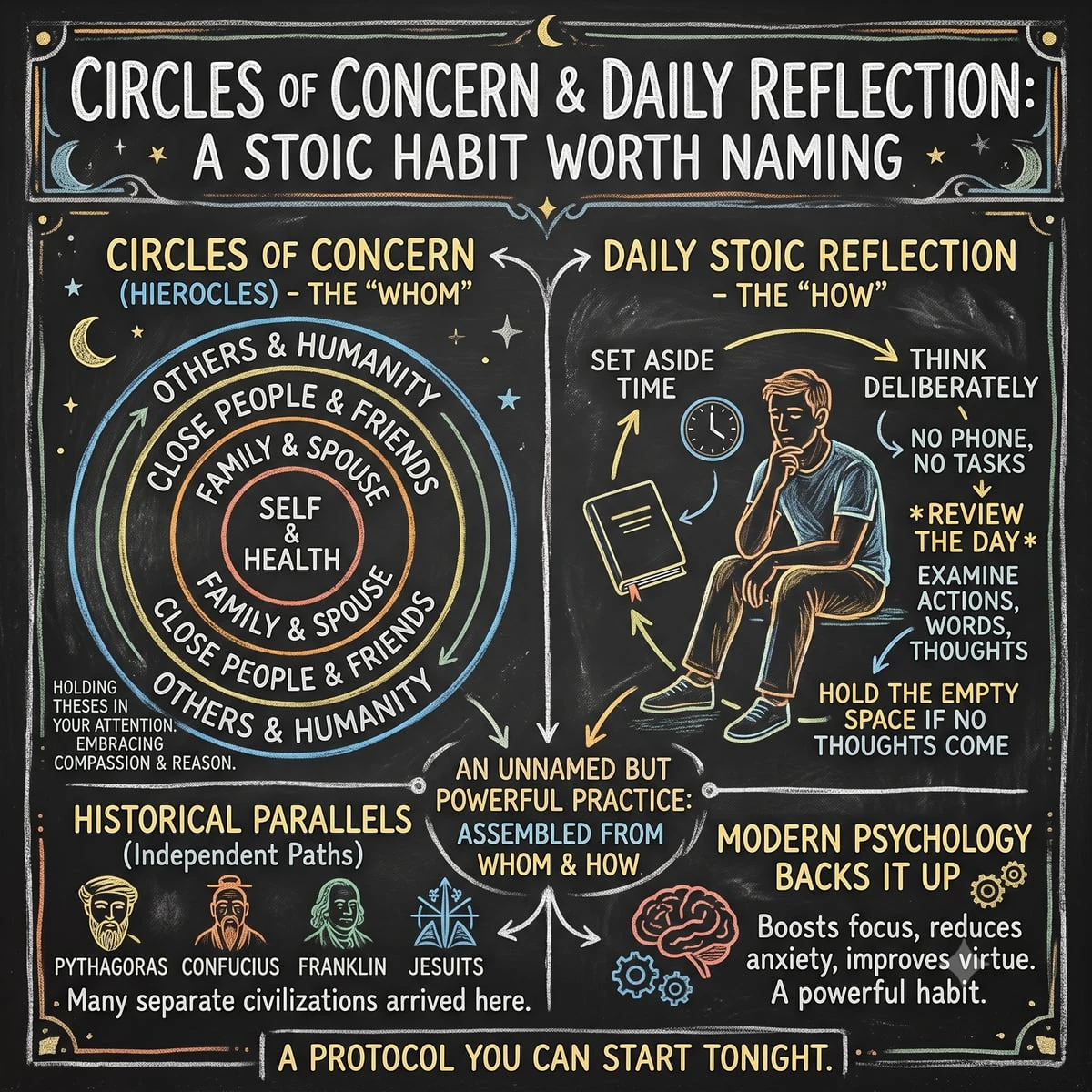
Hierocles was a Stoic philosopher of the 2nd century CE. We only have his picture of the circles because a 5th-century anthologist, Stobaeus, copied it out. He drew a person as the centre of a set of concentric circles: the first is the mind itself; then the body and what serves it; then parents, siblings, spouse and children; then relatives; then your local community; then fellow citizens; then countrymen; and at the outer edge, the whole human race.
His instruction is the interesting bit. Maturity, he said, is the work of drawing the outer circles inward, pulling the far people closer, learning to treat them with the warmth you reserve for those nearest you. In the original this discipline is called oikeiōsis (Greek oikeiōsis, roughly “appropriation” or “making something one’s own”), recognising other people’s concerns as your own. Massimo Pigliucci, in How to Be a Stoic, puts it plainly: in time it becomes clear that the common good is no less important than your own, they are two sides of the same coin.
That same image of widening circles re-appears, flipped, in modern ethics. In 1869 the historian W. E. H. Lecky described how “the benevolent affections embrace merely the family, soon the circle expanding includes first a class, then a nation, then a coalition of nations, then all humanity.” The philosopher Peter Singer borrowed that line for his 1981 book The Expanding Circle. The difference is telling: Singer watches the circle widen across history; Hierocles asks you to contract it on purpose, every day. So the sequence “first myself and my health, then my spouse, then those close to me, then society” is simply walking Hierocles’s circles from the inside out. The order is not selfishness, it is the recognition that you cannot pour from an empty cup, and that concern radiates most honestly when it starts where you actually stand.
“Sitting and Thinking Every Day” Is the Stoic Practice of Daily Reflection
The second half of the practice is the regular, disciplined review. For the Stoics this was a daily exercise (Greek askēsis): it is not enough to grant a truth with your intellect, you have to practise it stubbornly until it becomes a habit, almost a reflex. And it is older than Stoicism. The Pythagorean Golden Verses already command it: “Let not sleep fall upon thy eyes till thou hast thrice reviewed the deeds of the past day”, asking where you went wrong, what you did, and what you left undone. (Notice the “thrice”: three fixed questions, the very shape of Confucius’s “examine myself three times a day,” which we will meet below.)
Seneca describes the classic evening review in On Anger (Book III), and he is honest about where he got it: from the philosopher Sextius, whose school had carried the habit down from the Pythagoreans. His description is intimate, not academic: “When the lamp is taken out of my sight, and my wife, who knows my habit, has ceased to talk, I pass the whole day in review before myself.” Sextius’s own questions were sharp and simple: What bad habit have you cured today? What fault have you resisted? In what way are you better? Seneca adds that, having faced the day’s failings, he can forgive them, “see that you don’t do it again; for now, I pardon you”, and that the practice earns “a sleep that is tranquil, deep and undisturbed,” because the mind becomes its own quiet observer.
The mirror image is the morning. Marcus Aurelius opens his Meditations by rehearsing what he is about to face and who he means to be when he meets it. It is worth remembering that one of the most famous self-help books ever written was never a book at all: its Greek title, Ta eis heauton, simply means “To Himself.” Marcus wrote it as a private journal, much of it on military campaign, in a fort on the Danube, with no intention of anyone ever reading it. That is the spirit of the slot: the value is not in squeezing out thoughts but in holding the quiet itself. An empty pause without distraction is already the work; attention is a trainable faculty, and sitting still with nothing pulling at you is exactly what builds it.
The Same Habit, Many Traditions
What makes this practice convincing is that wildly different cultures, with no contact, kept inventing it. In China, Confucius’s disciple Zengzi says in the Analects (Book 1, §4) that he examines himself daily on a few points: whether he has been loyal to others, sincere with his friends, and whether he has practised what he was taught, 三省吾身 (sān xǐng wú shēn), “three times I examine myself.” The Buddha, in the Upajjhatthana Sutta, prescribes Five Remembrances “that one should reflect on often, whether one is a woman or a man, lay or ordained”, on aging, illness, death, loss, and the consequences of one’s actions.
It is just as alive in the West. Benjamin Franklin built his whole day around two questions: in the morning, “What good shall I do this day?”, and at night, “What good have I done to-day?” He carried a little notebook with a page for each of thirteen virtues, ruled into seven columns, one per day, and marked “a little black spot” against every fault he caught on review. The Jesuits formalised the same instinct as the Examen: a short daily prayer in which you become still, look back over the day with gratitude, notice where you fell short, and turn toward tomorrow. Ignatius of Loyola made it one of the very few prayers a Jesuit was never allowed to skip, twice a day, at noon and at night. Five traditions, one tool: a brief, fixed, daily audit of yourself against a handful of stable questions. When that many people reach for the same instrument, it is usually because it works.
What the Science Says About Daily Reflection
This is no longer just philosophy. In a field experiment run with Harvard Business School researchers (Di Stefano, Gino, Pisano & Staats), call-centre workers in training were split into groups. One group spent only the last fifteen minutes of each day writing down what they had learned. By the final assessment they scored 22.8% higher than colleagues who used those same fifteen minutes to keep working. A lab version with brain-teasers found reflectors did about 18% better on the next round. The proposed mechanism is self-efficacy: reflection turns raw experience into confidence and a usable lesson, but only once you actually have experience to reflect on.
Writing about your inner life has measurable effects too. In James Pennebaker’s classic studies, students who wrote for fifteen minutes a day over four days about an emotional upheaval made roughly half as many visits to the health centre in the following six months; a later replication found improvements in immune function. And there is a clue about how to review yourself. Psychologists Igor Grossmann and Ethan Kross documented “Solomon’s paradox”: we reason far more wisely about a friend’s problem than about our own. The fix is to step back, to consider your day from a slight distance, almost in the third person. Done that way, the wisdom gap disappears, and it does so equally for the young and the old. (Their paper opens, fittingly, with Solomon himself: “The way of a fool is right in his own eyes.”) If you have ever felt that awareness matters more than certainty, this is the same lesson from the laboratory.
A Practical Protocol by Circles (5–10 Minutes)
One quiet slot a day, no gadgets. You can split it into a morning tuning (what kind of day do I want to meet?) and an evening review (how did it actually go?), exactly Marcus’s morning and Seneca’s night. Walk the circles from the inside out.
- Circle 1, Myself and my health. How do I feel: body, sleep, energy? What steadied me today and what threw me off? One action for tomorrow for the sake of my own state. (This is also where you keep the means and the end apart, see goal-oriented versus state-oriented living.)
- Circle 2, My spouse. Did I give real attention, or the leftovers of my attention? What is she carrying right now that I never asked about? One concrete gesture for tomorrow.
- Circle 3, Those close to me. Whom have I not written or called in too long? Who deserves a thought before they have to remind me they exist?
- Circle 4, Society. Where did my work touch other people today, colleagues, partners, the city? Where could I have been more useful, or more honest?
If you want a ready-made frame, the historical ones still work. Franklin’s two questions (“What good shall I do today?” / “What good have I done?”) bookend the circles nicely. Modern practitioners keep it just as small: writer Ryan Holiday runs a roughly fifteen-minute morning ritual across a couple of notebooks; Tim Ferriss’s widely used “Five-Minute Journal” asks, each morning, what you are grateful for and what would make today great, and each evening, three good things that happened and how the day could have been better. Pick one and keep it. If a circle brings no thoughts, that is fine, hold the pause, do not fill it. The thought often arrives precisely in the silence.
Why Daily Reflection Works, and How Not to Ruin It
The practice is deceptively simple, which is also how it gets quietly sabotaged. A few guardrails keep it honest:
- It is not a to-do list. The point is to see clearly, not to manufacture tasks. A single concrete action per circle is a by-product, not the goal.
- The evening review is honest, not punitive. Seneca audits the day calmly, like a judge, then pardons himself and moves on. Self-flagellation is just another way of avoiding the quiet, and, as it happens, our weaknesses and doubts are what make us stronger only when we face them without contempt.
- Consistency beats duration. Five honest minutes every day outperform an hour once a month, the Harvard workers needed only fifteen. Anchor it to a habit you already have: after brushing your teeth, before closing the laptop.
- The phone stays out. The empty space is the instrument. The moment you let a screen in, you have filled the silence with someone else’s agenda.
Start small: one circle, two minutes, the same time each day. The structure, self, then those near, then those far, does the rest, because it is the same path Pythagoras, the Stoics, Confucius, the Buddha and Franklin all wore smooth long before us.
I write about technology, leadership, and the quiet habits behind clear decisions. If a conversation would help, get in touch here.
Frequently Asked Questions
What is this habit actually called?
It has no single name. It is the union of two Stoic ideas, Hierocles’s “circles of concern” (whom to hold in attention) and the Stoic daily reflection, or evening review (how to do it), with close analogues in Confucianism, Buddhism, Benjamin Franklin’s routine and the Jesuit Examen. In short, you can call it a daily reflection structured by circles of concern.
Is there real evidence it works?
Yes. A Harvard Business School field study found that fifteen minutes of end-of-day reflective writing raised performance by nearly 23%. Pennebaker’s expressive-writing research links short daily writing to fewer doctor visits and better immune function, and Grossmann & Kross show that reviewing your day at a distance (“Solomon’s paradox”) makes your judgement wiser.
Is this the same as meditation?
It overlaps but is not identical. Meditation usually trains attention on the breath or the present moment; this practice deliberately directs attention along a structure, self, spouse, close ones, society, and reviews how you acted. What they share is holding a quiet, undistracted slot.
Morning or evening?
Both, classically. Marcus Aurelius tuned himself in the morning; Seneca reviewed the day at night. If you only have one slot, the evening review is the single most powerful habit.
What if no thoughts come?
That is expected and fine. The empty pause is itself the exercise, you are training the capacity to sit with your own attention. Do not fill the silence; the thought usually arrives in it.
Sources
- Hierocles the Stoic, Elements of Ethics (the circles, preserved by Stobaeus), overview.
- Pythagorean Golden Verses, the nightly “thrice review”, translations.
- Seneca, On Anger (De Ira), Book III.36, the evening review, borrowed from Sextius, full text.
- Marcus Aurelius, Meditations (“To Himself”), overview.
- Confucius, Analects 1.4, Zengzi’s daily self-examination (三省吾身).
- Benjamin Franklin, Autobiography, the two daily questions and the thirteen virtues, text.
- The Jesuit Daily Examen, Ignatian Spirituality.
- Di Stefano, Gino, Pisano & Staats, “Learning by Thinking: How Reflection Aids Performance”, HBS Working Knowledge.
- Peter Singer, The Expanding Circle (1981), Princeton University Press.
Need a Consultation?
If you would like to talk, about technology leadership, decision-making, or anything this raised, book a free 15-minute call.