COC Realty is a Kazakhstani full-cycle company serving the oil and gas projects of Western Kazakhstan: it builds and operates housing and production bases, and feeds and transports personnel at the fields. It has been running since 2004, and its clients include the largest domestic and international oil and gas corporations.
I hold the position of IT Director at the company. Below is a look at the IT perimeter of a business like this: why it is harder here than in a typical service company, what was built, and what it delivered operationally.
- The problem: IT for a distributed field operation
- One IT architecture for COC Realty
- Transport: dispatching and telemetry
- Connectivity and managing remote sites
- Security and standards compliance
- The scale of the business IT serves
- My role in the project
- References
- Frequently Asked Questions
- Need a Consultation?
The problem: IT for a distributed field operation
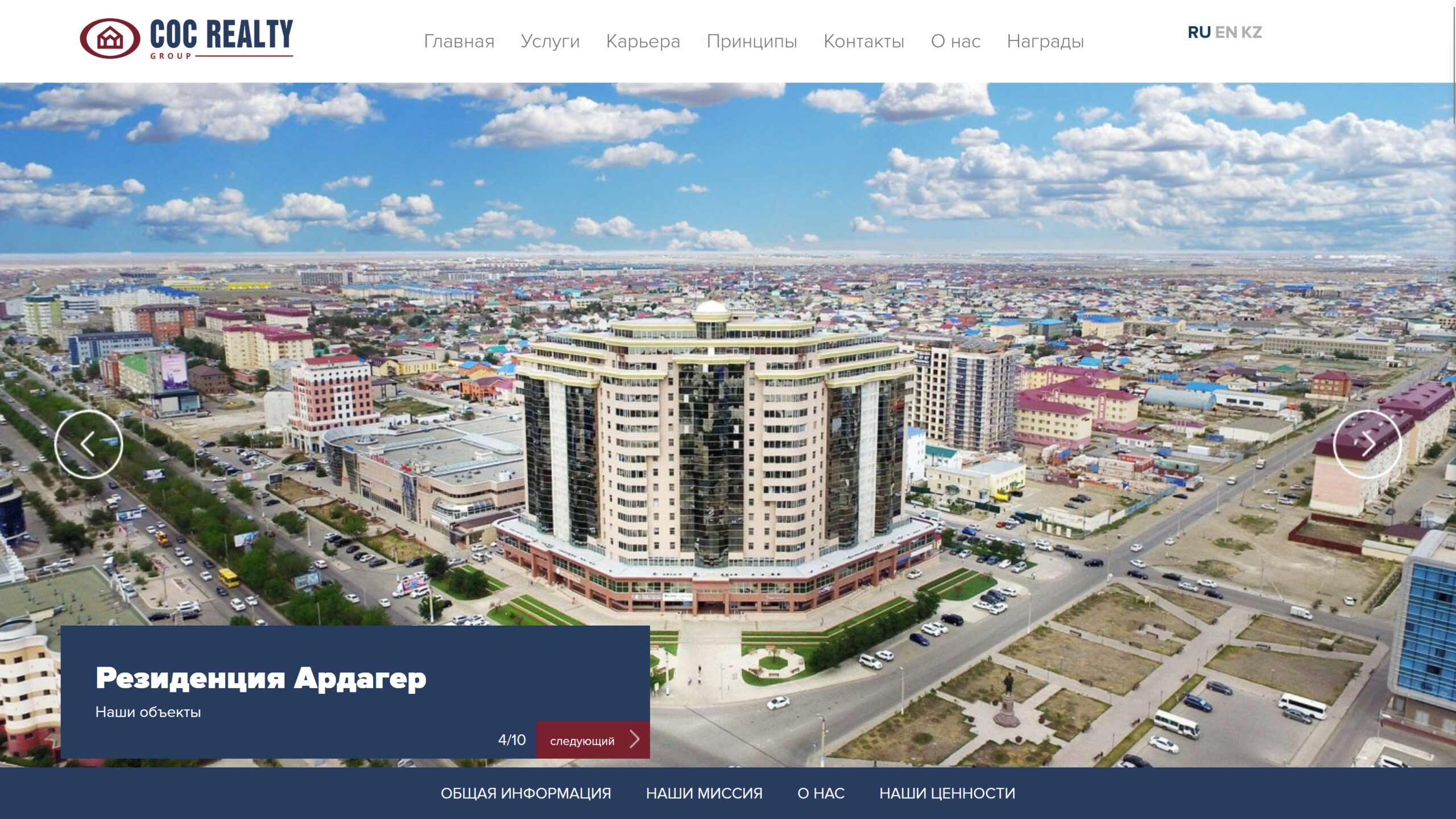
The particular challenge is that the business is physically spread across the region and consists of very different operations at the same time. Headquarters sits in Atyrau, facilities stand at the fields (including Tengiz), residences and rotational camps are hundreds of kilometres from the nearest city, the vehicle fleet is constantly moving, and there is an in-house food production plant and active construction sites.
Historically each line of business kept its own records: hotel services separately, transport separately, warehouse and catering separately, construction separately. For management that meant there was no consolidated picture, and decisions were made on yesterday’s reports. Connectivity is a separate difficulty: at remote sites the channel is limited and unstable, while downtime on an oil and gas project is expensive both in money and in reputation.
One IT architecture for COC Realty
The core work at COC Realty is bringing very different divisions into a single information space. A corporate ERP system was implemented, and around it sit resource accounting and planning across every line: accommodation, catering, transport, warehousing, construction, and facility maintenance.
The practical effect lies not in the system itself but in the fact that operational data is consolidated and available in real time. Management sees a connected picture rather than disconnected departmental reports: where the vehicles are, how many rooms are occupied, what the warehouse holds, how construction is progressing. Automated reporting removed the manual assembly of figures, and with it the usual errors of copying data between spreadsheets.
Transport: dispatching and telemetry
Transport is the most IT-demanding line at COC Realty: more than 800 vehicles and fifteen hundred drivers working at remote fields, where road safety is a critical metric for the client.
Digital dispatching with GPS monitoring gives visibility on every vehicle: route, driving behaviour, compliance with procedures. This is not control for its own sake but a direct contribution to safety and to the provability of the numbers reported to the client. One of the company’s projects passed the mark of 150 million kilometres without a road accident, a figure you have to reach and then be able to prove with data.
Connectivity and managing remote sites
For COC Realty facilities beyond normal coverage, channels and telemetry were built so that headquarters can see the current situation at the field: system status, environmental parameters, deviations. The point is to react to a signal rather than to a phone call after the fact.
A separate task is designing network and server infrastructure for that geography: a failed link or node must not stop service at a facility. The same principles I apply in other projects are at work here, namely redundancy, segment isolation, and predictable behaviour on failure, as in Monolith Plus.
Security and standards compliance
Because COC Realty works with international oil and gas consortia, the IT perimeter has to satisfy their corporate requirements rather than only internal ideas of convenience. Information security, access procedures, and integration with client corporate standards are a mandatory part of the job, without which a contractor is simply not admitted to the project.
The same applies to the industry standards the company is certified against: ISO 45001 for occupational health and safety, and ISO 22000 for food safety, which matters given the in-house food production. IT provides the traceability here: the data that demonstrates procedures were followed.
The scale of the business IT serves
- Accommodation: over 1,000 rooms and apartments across residences, rotational camps, and full-service hotels.
- Catering: an in-house food production plant and a full catering cycle at the facilities.
- Transport: more than 800 vehicles, over 1,500 drivers and operators, with maintenance complexes in Atyrau and at the Tengiz field.
- Construction: since 2017, more than 570,000 m² of housing and 10.5 km of roads, plus reconstruction of infrastructure facilities.
The company’s business model is full cycle: COC Realty acts simultaneously as investor, developer, contractor, and operator of its own facilities. For IT that means one system has to serve construction, hotel services, and logistics at once, processes with completely different logic but shared data.
My role in the project
IT Director at COC Realty. I am responsible for the company’s digital strategy, the development of its IT infrastructure, and the management of the IT team that keeps distributed facilities running across Western Kazakhstan, including the Tengiz field.
- IT strategy and budget: planning the roadmap and prioritising investment.
- Corporate infrastructure: network architecture, server hardware, and connectivity for remote sites.
- ERP and reporting automation: unified accounting across the lines of business and end-to-end data for management.
- Information security and integration with the corporate standards of international consortia.
- IT team management and support for compliance with ISO 45001 and ISO 22000.
References
Frequently Asked Questions
What does COC Realty do? It is a Kazakhstani full-cycle company for oil and gas projects in Western Kazakhstan: building and operating facilities, accommodating personnel, catering, transport, and logistics at remote fields. Operating since 2004.
What makes IT difficult here? The operations are distributed and very different in nature, and facilities sit hundreds of kilometres away with limited connectivity. Everything has to come into one information space while remote sites keep running.
Why GPS dispatching in transport? It gives visibility on routes and compliance at remote fields, and lets safety numbers be proven with data, up to 150 million kilometres without an accident on one project.
Which standards must the infrastructure meet? The corporate security and access requirements of international consortia, plus data traceability for ISO 45001 and ISO 22000.
Need a Consultation?
If you run a distributed operation with remote sites and fragmented record-keeping and want to consolidate it into a manageable IT architecture, book a free 15-minute call. We will go through your situation and work out where to start.