Telegram lets you sign up with a number that was never issued by a mobile carrier and never lived in a SIM card: a virtual number in the +888 range. People call it “anonymous,” and in one specific sense it is, but that word hides as much as it reveals. Before you spend thousands of dollars on one, it is worth understanding exactly what you are buying, what it protects you from, what it does not, and the single mistake that would lose both the number and the money behind it. This is a practical walk-through of an anonymous Telegram number, written the way I would brief a client who asked “should I get one?”
- What an anonymous Telegram number actually is
- The one place you can buy it: Fragment
- What “anonymous” really means here (read this part)
- What it costs
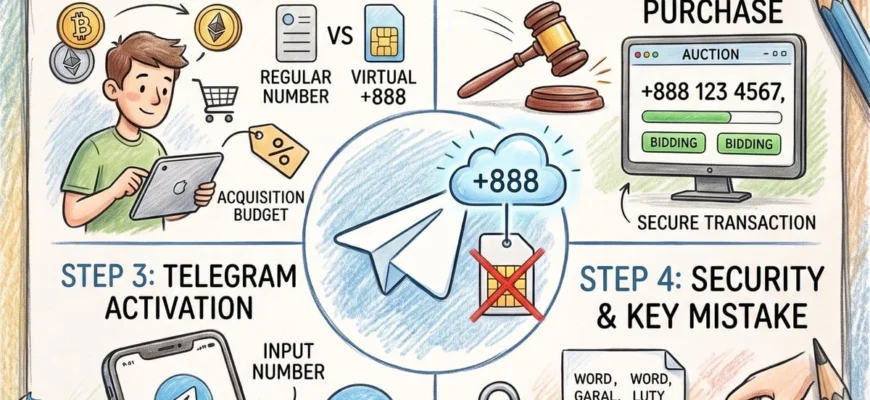
- Step by step: from wallet to working number
- 1. Set up a TON wallet
- 2. Fund it with TON (plus a margin)
- 3. Connect your wallet to Fragment
- 4. Pass identity verification (KYC)
- 5. Choose your number
- 6. Confirm the transaction
- Where the login codes come from (not SMS)
- The risk that actually matters
- So, should you get one?
- Frequently Asked Questions
- Sources & Tools
- Need a Consultation?
What an anonymous Telegram number actually is
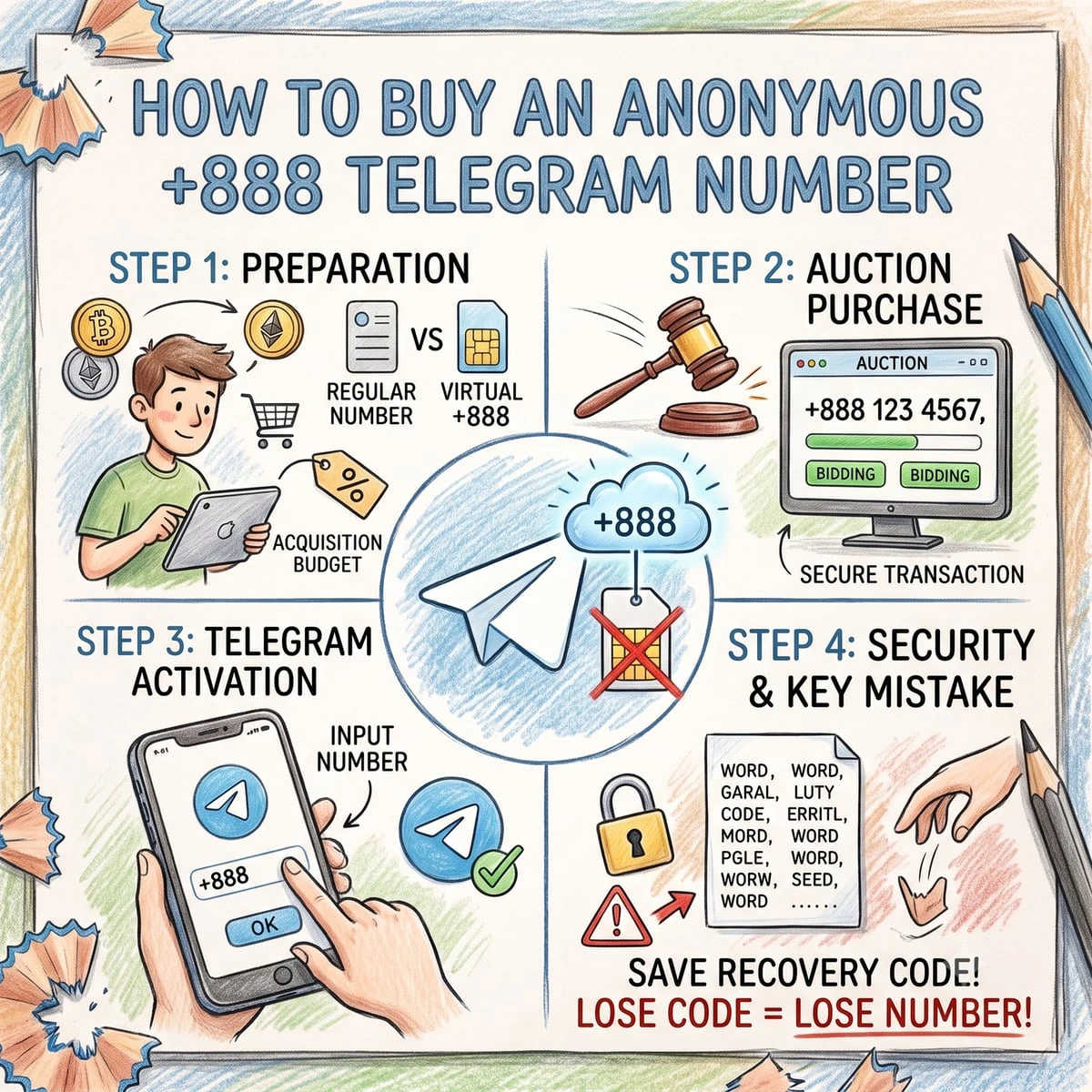
A +888 number is not a phone line. It is a blockchain asset: an NFT that lives on the TON network and that Telegram recognises as a valid identity for signing in. There is no cellular network behind it, no SIM to insert, no monthly bill, and no operator who knows your name from the contract. You own it the way you own any token in a crypto wallet: whoever controls the wallet controls the number.
That is the real appeal. A normal Telegram account is tied to a SIM, and a SIM is tied to a person: bought with an ID in most countries, logged by the carrier, reachable by anyone who can pressure that carrier. A +888 number cuts the carrier out of the loop entirely. It cannot be SIM-swapped, it will not stop working because you changed countries or let a prepaid plan lapse, and it does not sit in a telecom database with your passport photo attached. For that reason it is genuinely useful to people who travel constantly, who separate a public-facing identity from a private one, or who simply do not want their messenger login welded to their mobile subscription.
The one place you can buy it: Fragment
There is exactly one legitimate marketplace for these numbers: Fragment, the official auction platform built on TON. Anything else advertising “anonymous +888 numbers” at a discount is a reseller at best and a scam at worst. On Fragment the number is minted and transferred on-chain, so ownership is public, verifiable, and yours the moment the transaction confirms. You do not create an account with an email and password; you connect a TON wallet, and that wallet is your login.
What “anonymous” really means here (read this part)
This is where most write-ups mislead you, so let me be precise. The number is anonymous toward the mobile ecosystem: no carrier, no SIM registration, no telecom record. It is not anonymous toward the platform. As of 2026, buying a +888 number on Fragment requires full identity verification. You cannot complete a purchase without passing KYC (“know your customer”) through Sumsub: a real passport or government ID plus a live selfie. The days of buying one with no documents at all are over.
So the honest description is not “untraceable.” It is “decoupled from your phone carrier, and pseudonymous to everyone except the marketplace and its verification provider.” That distinction matters enormously depending on your actual threat model. If you are shielding yourself from SIM-swap attackers, spam databases, or a stalker who could sweet-talk a call-centre agent, a +888 number is a strong tool. If your threat model includes a government that can subpoena Fragment or Sumsub, it is not the shield you think it is. Buy the thing for what it does, not for the marketing word attached to it.
What it costs
These numbers are not cheap, and the price is a moving target because it is denominated in Toncoin (TON), whose exchange rate floats. At the time of writing, with TON at roughly $1.51:
- Floor price (an ordinary, randomly assigned number): from about 1,700 TON, which works out to roughly $2,500 to $2,900.
- Premium numbers (short, memorable, or “beautiful” patterns): sold by auction, and the good ones reach tens or even hundreds of thousands of dollars.
- Network fees: small TON transaction fees on top, so always fund the wallet with a margin above the sticker price.
Because the price is quoted in TON, a swing in the token’s exchange rate moves your dollar cost even if the TON figure stays flat. Never treat a number you saw last week as the price today. Check the live floor on Fragment before you commit, and budget in TON, not in dollars.
Step by step: from wallet to working number
The process is short, but two steps carry consequences that are hard or impossible to undo. I have flagged them.
1. Set up a TON wallet
Install a wallet that supports the TON network, such as Tonkeeper. The instant it generates your seed phrase (the list of recovery words), write it down and store it somewhere safe and offline. This is the step that cannot be walked back: losing the seed phrase means losing the wallet and the number inside it, with no recovery, no support line, and no appeal. Treat those words as the number itself, because functionally they are.
2. Fund it with TON (plus a margin)
Buy Toncoin on an exchange and send it to your wallet. Fund it comfortably above the floor price (from around $2,500 for an ordinary number) so that network fees and small rate movements do not leave you short at checkout.
3. Connect your wallet to Fragment
Go to Fragment and click Connect Wallet. There is no separate signup: the wallet you connect is your account and your proof of ownership.
4. Pass identity verification (KYC)
Complete the Sumsub check: upload a passport or ID and take a live selfie. Purchases are blocked until this clears, so there is no way around it. Expect the same document handling as any regulated fintech onboarding.
5. Choose your number
You have two paths:
- Random (floor price): open Numbers, choose Random, and buy an available lot at the floor. Fastest and cheapest.
- Auction (premium): browse the active lots, pick a number you want, click Place Bid, and be prepared to outbid others. This is where prices climb.
6. Confirm the transaction
Click Buy or Place a Bid and approve the operation in Tonkeeper. Once the on-chain transaction confirms, the NFT (your number) lands in your wallet and it is yours.
Where the login codes come from (not SMS)
This trips people up on the first login, so it is worth stating plainly. Because there is no SIM and no cellular line, your Telegram sign-in codes do not arrive by SMS. They are issued on Fragment itself. When you log in to Telegram with your +888 number, go to Fragment, My Assets, your number, Get Login Code, and enter the code Fragment shows you into the Telegram app. That flow is the number in action: the blockchain asset, not a phone network, is what authenticates you.
The risk that actually matters
Every other risk here is secondary to one fact: the number is an NFT, and whoever holds the wallet holds the number. There is no “forgot password,” no identity-based recovery, no human at Telegram or Fragment who can restore access if your keys are gone. This cuts both ways. It is exactly why the number cannot be SIM-swapped or seized from your carrier, and it is exactly why a lost seed phrase or a drained wallet is final. If someone phishes your recovery words, they do not just empty your balance; they walk away with your Telegram identity too.
So the security of a +888 number is really the security of your wallet. Back up the seed phrase offline and in more than one place, never type it into a website or share it with “support,” and if the number matters to you, consider a hardware wallet so the keys never touch an internet-connected machine. The same discipline that protects a serious crypto holding, the kind I describe in my personal crypto tools, is what protects this.
If the number is a company asset rather than a personal one, custody and recovery rules belong in the access-control layer of an information security programme.
So, should you get one?
A +888 number is a good fit if you want a Telegram identity that no mobile carrier can touch, you can absorb a several-thousand-dollar cost that floats with a crypto exchange rate, and you are comfortable being your own bank: sole custody of a wallet, no recovery net. It is a poor fit if you expected true, document-free anonymity (KYC ended that), if you cannot reliably safeguard a seed phrase, or if you just need a throwaway number for one signup, in which case you are massively overpaying. Bought clear-eyed, it is a genuinely useful piece of personal infrastructure. Bought on the strength of the word “anonymous” alone, it will disappoint on the exact axis you cared about.
Frequently Asked Questions
Sources & Tools
- Fragment: the official TON auction platform for +888 numbers.
- TON and Toncoin (TON): the network the number lives on and the token you pay in.
- Tonkeeper: a TON wallet for holding the number and approving the purchase.
- Sumsub: the identity-verification provider Fragment uses for KYC.
Need a Consultation?
If you are weighing privacy tools like this against your actual risks, and you want an honest read on what protects you and what only looks like it does, book a free 15-minute call.