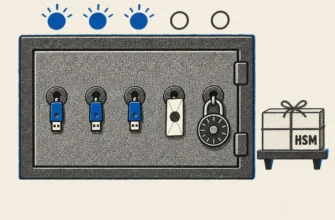
A single hardware wallet is a single point of failure. Firmware backdoor, compromised vendor, someone physically grabbing your device and extracting the seed, any one of these and your funds are gone. Multisig hardware wallet security fixes this by requiring multiple independent keys to sign a transaction. With a 2-of-3 setup using hardware wallets from different manufacturers, no single device compromise can drain your wallet. The Ledger Recover scandal in 2023 made this point more convincingly than any security whitepaper ever could.
This guide covers how multisig works at the protocol level for both Bitcoin and Ethereum, why mixing hardware vendors matters, which coordinator software to use, and the part most guides skip entirely: backup strategy for wallet descriptors. If you hold more than $50–100K in crypto, this approach to multisig hardware wallet security is not paranoia, it is basic operational security.
- How multisig works
- Bitcoin: P2WSH and P2TR
- Ethereum: Smart contract wallets
- Why different hardware vendors
- The 2-of-3 setup
- Coordinator software
- Bitcoin coordinators
- EVM coordinators
- What to back up (and where)
- Three things to store separately
- Pitfalls
- Capital layering
- FAQ
- What if one hardware wallet manufacturer goes out of business?
- Can I do multisig with just software wallets?
- Is 3-of-5 better than 2-of-3?
- Do I need to run my own Bitcoin node for multisig?
- What happens if I lose the wallet descriptor?
- Summary
- Need a consultation?
How multisig works
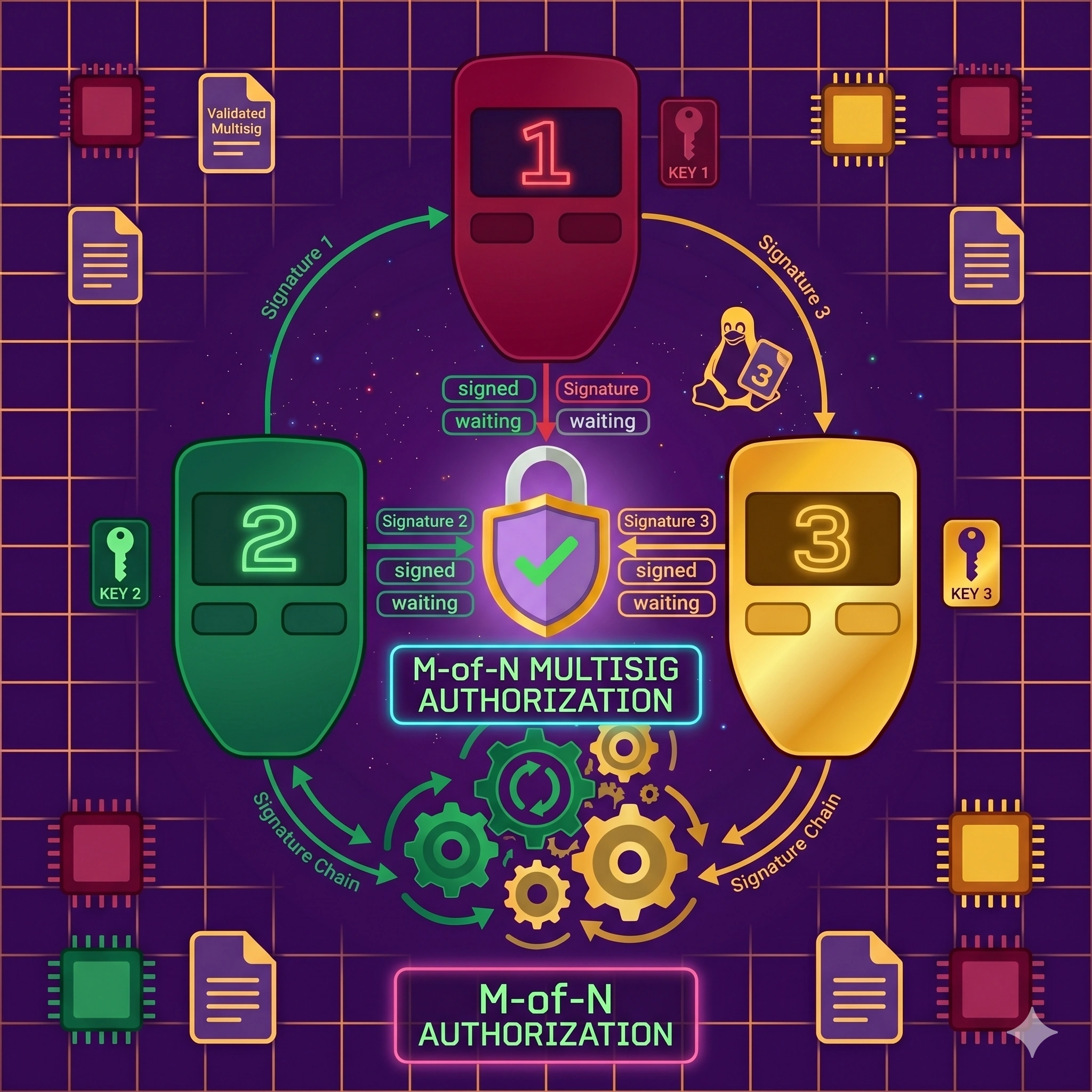
A multisig wallet is an address that requires N out of M signatures to authorize a transaction. The most common configuration is 2-of-3: three keys exist, any two must sign. The address itself encodes this rule, the blockchain enforces it directly. No middleman, no custodian, no trust assumptions beyond the math.
Bitcoin: P2WSH and P2TR
On Bitcoin, multisig is native to the protocol. A 2-of-3 address is created using a redeem script that lists three public keys and the threshold rule. Modern wallets use P2WSH (Pay-to-Witness-Script-Hash) for SegWit compatibility, or P2TR (Pay-to-Taproot), which hides the multisig structure on-chain until a non-cooperative spend happens. Taproot multisig looks like a regular single-sig transaction when all parties cooperate. Better for privacy, cheaper on fees.
Ethereum: Smart contract wallets
Ethereum doesn’t have native multisig. Instead, you deploy a smart contract that holds funds and checks signatures before releasing them. Safe (formerly Gnosis Safe) is the industry standard here, securing over $100B in assets across EVM chains. The tradeoff: every transaction costs more gas because you’re executing contract logic, not just a simple transfer.
Why different hardware vendors
Vendor diversity is the heart of multisig hardware wallet security: if all three keys live on the same brand of hardware wallet, a single firmware vulnerability compromises your entire setup. This is not theoretical. In 2023, Ledger announced Ledger Recover, a feature that could extract and shard your seed phrase through a firmware update. Whether or not you consider this a vulnerability, it proved something important: a vendor can push one update that fundamentally changes the security model of your device. If your 2-of-3 was three Ledgers, that single decision by one company would have affected all three keys.
With different vendors, a firmware bug or supply chain attack on one manufacturer compromises at most 1 key out of 3. Your funds stay safe. Same principle behind using multiple cloud providers or multiple DNS servers, vendor diversity as a security control. If you’ve worked in infrastructure, this is second nature. Apply it to your keys the same way you’d apply it to your hardware-backed authentication.
The 2-of-3 setup
A practical 2-of-3 configuration for significant holdings:
| Key | Device | Location | Purpose |
|---|---|---|---|
| Key 1 | SafePal X1 | Home, active use | Day-to-day signing |
| Key 2 | Coldcard Mk4 / Q | Home safe or office | Second signature for routine transactions |
| Key 3 | Trezor Safe 5 / BitBox02 | Bank safe deposit box, lawyer, or another country | Disaster recovery |
For a regular transaction, you sign with Key 1 and Key 2. Both are accessible at home, so the process takes minutes. If your home is compromised (fire, theft, raid), Key 3 in a separate physical location plus any one recovered key (from seed backup) restores full access.
The geographic separation of Key 3 matters more than people think. Keeping it in a different jurisdiction adds protection against localized threats: natural disasters, government seizure, or break-ins. For someone with ties to multiple countries, this is natural. Store Key 3 wherever you have a trusted relationship but don’t live full-time.
Coordinator software
The coordinator is the software that creates the multisig wallet, builds unsigned transactions, collects signatures from each device, and broadcasts the final transaction. It never holds private keys.
Bitcoin coordinators
- Sparrow Wallet (desktop, open source). The best option for most people. Clean UI, full coin control, connects to your own node or public Electrum servers. Supports all major hardware wallets.
- Specter Desktop (desktop, open source). More technical, tighter Bitcoin Core integration. Good if you already run a full node.
- Nunchuk (mobile + desktop). Better mobile experience. Has collaborative multisig features for teams or families.
- Keeper (mobile). Bitcoin-only, polished mobile UX.
EVM coordinators
- Safe{Wallet} (web app). The standard for Ethereum, Polygon, Arbitrum, BSC, and other EVM chains. Battle-tested with years of production use. Supports transaction batching and spending policies.
What to back up (and where)
This is where most multisig setups quietly fail. People back up their seed phrases, assume that’s enough, and move on. It’s not.
Three things to store separately
1. Seed phrases for each device. Store on metal (steel plates, Cryptosteel, Billfodl), not paper. Each seed goes to a different physical location. Never store two seeds together.
2. Wallet descriptor (or the set of all xpubs + derivation paths + the quorum rule). This is the piece most people miss. A wallet descriptor tells the coordinator software which public keys form the multisig and what the signing threshold is. Without it, you cannot reconstruct the multisig address even if you have all three seeds. Back up the descriptor alongside each seed so that any single backup location contains enough information to begin recovery.
3. PINs and passphrases. Store separately from seeds, ideally in a password manager with hardware approval. If someone finds your seed + passphrase together, they have your key. A passphrase stored with the seed is the same as no passphrase.
Pitfalls
- Multisig adds complexity to every transaction. For small amounts, it’s overkill. Don’t multisig your coffee money.
- On EVM chains, multisig means a smart contract, which means higher gas costs per transaction. On L2s (Arbitrum, Optimism) this is less painful, but still more than a simple EOA transfer.
- Not all altcoins support multisig natively. Many tokens on EVM chains work fine through Safe, but non-EVM chains vary widely. Check before you move funds.
- Losing the wallet descriptor makes recovery extremely difficult even with all seeds. Treat it like a fourth key.
- Coordinator software compatibility: not all wallets export descriptors in the same format. Test your full recovery process before storing real funds.
Capital layering
Not all funds need the same level of protection. A practical split:
| Layer | Storage | Amount | Use case |
|---|---|---|---|
| Hot | Phone wallet (MetaMask, Trust) | Up to $1-5K | Daily spending, DeFi interactions, gas |
| Warm | Single-sig hardware wallet (SafePal X1) | $5-50K | Medium-term holdings, regular trades |
| Cold | 2-of-3 multisig (SafePal + Coldcard + Trezor) | $50-100K+ | Long-term BTC/ETH holdings, generational wealth |
The boundaries are personal. The principle is: the harder it is to spend, the more secure it is. Match the friction to the value at risk.
FAQ
What if one hardware wallet manufacturer goes out of business?
Your keys are derived from the seed phrase, not from the device. If a manufacturer disappears, import the seed into a different BIP39-compatible wallet. The multisig structure is defined by the descriptor, not by any specific hardware. The device is just a signing tool.
Can I do multisig with just software wallets?
Technically yes, but it defeats the purpose. Software wallets run on general-purpose operating systems that are vulnerable to malware, keyloggers, and remote exploits. The point of hardware wallets is that the private key never touches an internet-connected device.
Is 3-of-5 better than 2-of-3?
More keys means more resilience against compromise but also more complexity and more things to back up and maintain. For individual holders, 2-of-3 is the practical sweet spot. 3-of-5 makes sense for organizations where multiple people need to approve transactions.
Do I need to run my own Bitcoin node for multisig?
Not strictly, but it improves privacy. Without your own node, your coordinator software queries a third-party server (like a public Electrum server) which can see your addresses and balances. For large holdings, running a full node removes that exposure. Sparrow Wallet makes this straightforward to configure.
What happens if I lose the wallet descriptor?
You still have the seeds, but you don’t know which public keys combine to form the multisig or what derivation paths were used. Recovery is possible but painful: you’d need to try combinations of xpubs and derivation paths until you find the right one. Some coordinators (like Sparrow) can help with this, but it can take time and technical skill. This is why you back up the descriptor with every seed.
Summary
For holdings above $50–100K, multisig hardware wallet security with devices from different manufacturers is the minimum viable setup. Sparrow Wallet as the coordinator for Bitcoin, Safe{Wallet} for EVM chains. Seeds on metal in separate locations. Wallet descriptor backed up with every seed. Test recovery before you fund the wallet. The complexity is real, but so is the risk of a single point of failure, and you only have to learn that lesson once the hard way.
Need a consultation?
If you need professional expertise, book your free 15-minute consultation.